
Three months of doubt ended this week. Thousands of dollars went into rebuilding a 25-year-old spy game from 2D into 3D, and one question haunted every single decision along the way — does the indie game core loop survive the jump? Does what made this game special in 2D actually translate? Week 4 gave me the answer.
My name is Frank Salas. I run Salas Games, a fully remote indie studio rebuilding My Life as a Spy — a multiplayer espionage RPG — from scratch in Unity. This is the Week 4 devlog.
What Week 4 Set Out to Solve
Week 3 ended with parts, not a game, just witness systems. Combat existed. Inventory worked. NPCs moved around the map. The world had a day and night cycle.
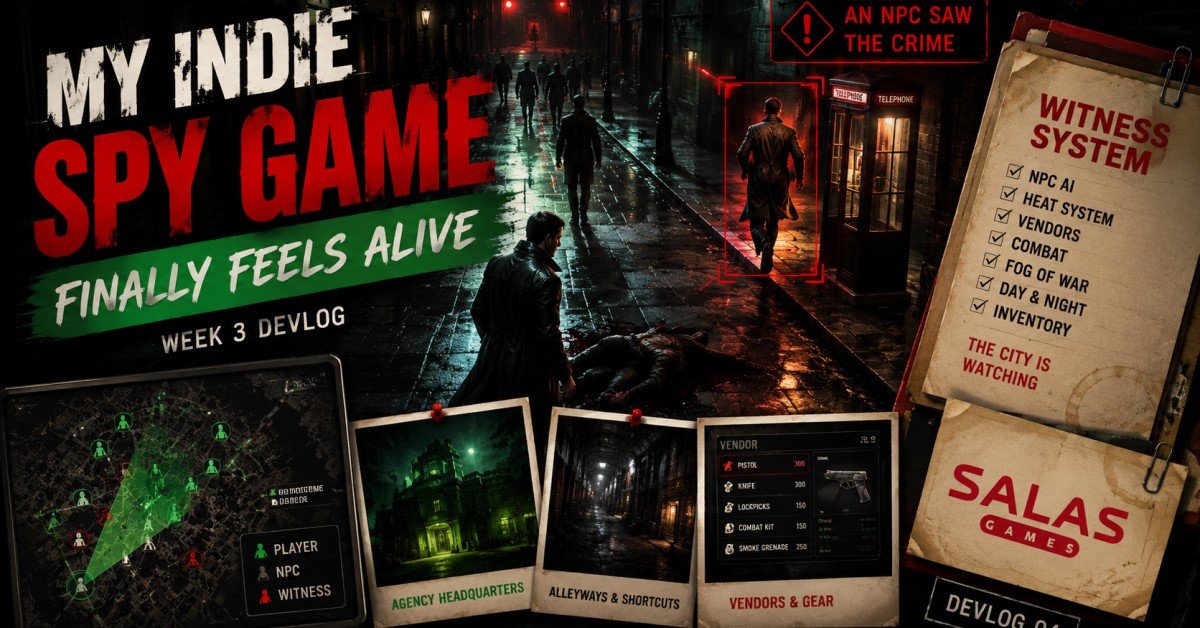
But nothing connected. Players had no reason to leave headquarters, no reason to fight anyone, and no real cost to dying. Every system sat on its own island.
Week 4 had one job — close the indie game core loop. Connect every system. Give players a reason to go out, a reason to fight, and something real to lose when they die.
I Spent Thousands Rebuilding a 25-Year-Old Spy Game. Is It Fun?
Closing the Indie Game Core Loop — Monday Delivered First
Monday locked in two systems back to back.
Multiplayer combat came first. Two agents connected live and fought in real time — punching, stabbing, shooting. Damage synced cleanly across the network.
Document running came next. A player walks to the agency clerk inside headquarters, picks up a classified document, carries it across the city, and drops it at a delivery point. Complete the run and earn cash plus training points.
For the first time, the indie game core loop had a clear beginning — go out, do something, get paid, and come back stronger.
Tuesday — The Junior Developer Who Broke Everything
Hiring a junior developer at the start of the week felt like the right move. Small tasks needed handling, and pulling the core team off their main work was not worth it.
By Tuesday afternoon, everything broke.
This developer had been copying AI-generated code, pasting it without proper integration, adding typos, and merging it straight into the build. A programmer friend reviewed the code and called it immediately: get rid of him today.
My systems engineer reverted the entire build within 45 minutes. The mess cost about two hours of work per developer across the whole team. But with that developer gone by end of day, three people in the back half of the week produced more than four had in the front half.
Sometimes removing one person unblocks everyone else.
How the Indie Game Core Loop Works in My Life as a Spy
Wednesday was the best day in the project’s history. Every piece of the indie game core loop connected and ran together in a single build for the first time.
Here is exactly how it plays.
Step 1 — Documents and the City
Connect to the server and pick your agency — red, green, or black. You spawn inside headquarters and walk up to the documents clerk. That NPC hands you a classified document with a delivery destination somewhere in the city. Grab it and head out.
The city is dangerous. Agents from rival agencies are running their own documents out there. Kill a rival and you steal their documents. Get killed and you lose yours.
Step 2 — Training Points and RPG Progression
Make your delivery, collect cash and training points, then head back to the training kiosk and pick a stat to improve. Eight stats shape your build: Brawn, Weapons, Stealth, Perception, Influence, Hacking, Trap, and Endurance. Costs scale fast and you cannot max everything. Pick a lane. Are you a bruiser? A ghost? A hacker?
Step 3 — Combat, Death, and Real Consequences
Gear up at vendors and go hunting. Combat is real-time multiplayer — shoot, stab, punch. When someone dies, training points drop, inventory items fall based on the Influence stat, and the hat pin always hits the ground. That hat pin is your agency badge, your rank trophy, your identity in the game.
Another player walks up to the corpse, presses one button, and grabs everything instantly. No menus, no delay. The corpse disappears in 7 to 9 seconds, so both sides are always under pressure.
Respawn at headquarters with half health and a lighter inventory. Then go back out.
That is the indie game core loop — documents, training, combat, death, consequences, respawn, repeat.
Why a Strong Indie Game Core Loop Pays Off Fast
After the death system went in, I walked the team through a gadget called the cyanide pill. Take it on purpose, die, but lower your item drop chance and destroy all documents in your inventory so the enemy gets nothing.
My developers said, “Done.”
I thought they misunderstood. I had just finished explaining it. But because they built every part of the indie game core loop with clean system architecture, adding this feature meant attaching a single component. Finished in under 60 seconds.
Strong foundations make every new feature fast to ship. That advantage compounds every single week of development.
Masks, Scanners, and Real Spy Gameplay
The indie game core loop handles the basic structure of the game. What turns this into a spy game — not just a shooter with document running — is the disguise system.
Equip a mask and your character changes color completely. Put a black mask on a red agent and every other player sees a black agent. Name tag, character model, all of it changes.
Each headquarters has cell scanners at the entrance. Your own scanner reads your identity and opens. An enemy scanner blocks you. But wear a high-quality mask matching that agency and the scanner reads the mask instead of you. Walk straight through their front door.
The catch matters. Agents with high Perception can see through your disguise. Get spotted inside enemy headquarters and your mask comes off automatically. Now you are trapped inside with no easy exit.
Wearing a disguise is a commitment, not a shortcut. That tension is what makes this feel like a real spy game at every level.
First Playtest — Testing the Indie Game Core Loop Live
Thursday evening, I downloaded the client build and connected to the server alongside my developers for the very first time.
Spawning into headquarters, I bought a weapon. After grabbing a document from the clerk, I walked outside and got into a fight. Death came fast. Stuff dropped, the respawn triggered, and I went straight back out.
The indie game core loop ran exactly as designed. I could not stop smiling.
Developers kept playing past the end of the workday. I had to tell them to go home. We set 15 playtest goals for that session and hit all but one — and that one had been working earlier before a last-minute build update broke it.
After the session, I went to the Discord and posted the answer to the question I had been sitting on for three months. The game is fun. In 2D and in 3D.
Going Over Budget — The Real Side of This Build
Letting the junior developer go freed up his salary budget, but that money went straight to a 3D artist. The right hire for the project, but it pushed me past budget immediately.
No publisher covers this. No investor writes checks. Every dollar comes from my own income — a staffing business I run separately. Going over budget comes directly out of my life.
My partner and I stopped eating at restaurants. All meals happen at home. Three days a week we eat vegan, which is probably good for me anyway. Beyond cutting lifestyle costs, I am selling my sneaker collection. Bought at retail in the US and shipped to Colombia, where import taxes on Nike products now run between 55 and 60%. That markup makes them worth more here than I paid. Whatever those sales bring in goes straight to developer salaries and the artist.
No glamour here. No investor. Just building.
The Indie Game Core Loop Is Done — What Comes Next
Combat, document running, death with real consequences, training, vendors, chat, masks, scanners, and save files all run together in one build. The project sits four months ahead of schedule.
Outside players cannot come in yet. Traps still need to go in. The hacking system has to be built. A full meta gameplay loop still needs to connect everything at a higher level.
When those systems land, the game shifts from a multiplayer action experience into a full espionage sandbox. Every gadget, every trap, and every disguise adds a new way to outmaneuver another player.
Week 4 was when My Life as a Spy stopped being a project and started being a game. Week 5 is when it starts becoming the game it was always meant to be.
Subscribe to follow the build every week. Join the Discord through the link in the video description — if you are there when the pre-alpha opens, you get an invite to play first.